Nowadays, travellers are becoming more exigent during their stay at hotels since they want to find the same comfort as they have at home. For this reason, hospitality industry has implemented different technologies aimed to meet those needs. With the development and implementation of the Hospitality Automation (or domotics technology), this goal has become more reachable.
The Hospitality Automation is a technology that gathers different features of the room hotel on a same platform to ease their personalization depending on the preferences of each customer. It can help to enhance the customer experience but also lead to cost reduction for the hotel.
The domotics technology enables the customer to manage different aspects on the room that will transform their stay into a memorable experience; for example: customer can choose their preferred music which will be played when the customer walks in, the time, the rooms and bath temperature, different scenarios, TV, curtains, and even make housekeeping requests. This system can already be found in luxury hotels like the Ritz Carlton, Plaza Athénée and the Negrezco but is not generalized in other hotels yet.
One of the pioneers to use this technology in hospitality industry was the Aria Hotel located in Las Vegas, with its implementation since 2010 of the Control4 Suit Management System. At the beginning, this system was managed by a remote control and the platform was visualized on a screen. This kind of system allows the customer to (Image 1):
- Visualize TV channels
- VOD for movies selection
- Lighting
- Temperature control
- The privacy and Security settings
- Wake/sleep bottom
- Curtains’ automation
- Mirror-TV control
- And other Services
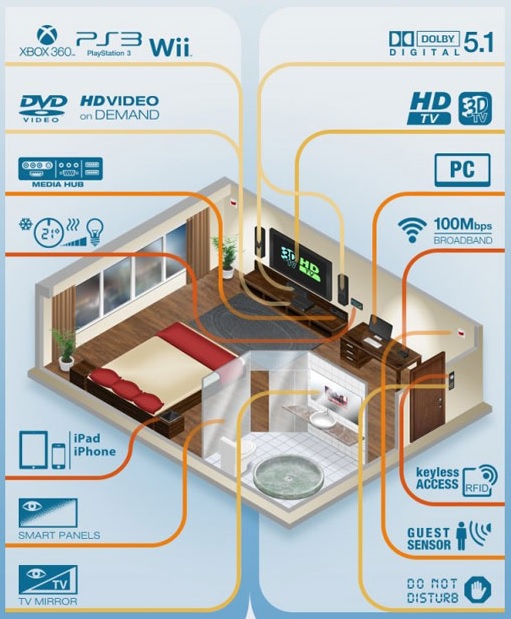
Image 1. High-tech hotels' rooms. (source: Domadoo’s blog, 2013).
The privacy and security settings allow changing the status of the room to “Do not disturb” in one touch rather than going to the door and hanging etiquette. In addition, this tool even allows the customer to know whether he/she has or not closed the door lock. Another feature included on the Control4 System is a direct connection with the McCarran International Airport of the city which shows accurate flights information directly to the customers. The “Wake/sleep bottom” has 2 main uses: The good-night timer and Wake-up. The good-night timer allows customers to choose an interval of 10 to 90 minutes time to turn off the TV, the light and close the curtains, as well as set a specific temperature for the night. On the other hand, the wake up function can change the temperature as well; wake you up with the TV on the news or customers favorite music. The customer is also allowed to choose the intensity of the light (10, 15 or 100%) or if the customer prefers to wake up with sunlight the curtains will open.
The main objective of the Hospitality Automation is to enhance the customer experience but it also represents some advantages for the hotel. This system will help with cost reduction (due to the wireless controlled systems) but the most important is the energy savings. The Control4 System enables to turn off the lights and the heater once the customer has checked out, but also offers the possibility to the hotel of reducing its light consumption by 10% for each room. This limitation won’t be perceived by the customer but will lead to important energy savings at the end of the year.
This system also enables a smart management of the hotel rooms, giving a better control of the hotel occupancy and allowing faster reaction once the customer has left rather than waiting until the Housekeeping service pass by.
The system is still evolving and trying to become a BYOD (Bring Your Own Device) technology where the customer only has to download an application on their smartphone and start the personalization of the room before their trip. It will also allow the customer to “save” their personal settings and with the use of their smartphone bring this personalization to another hotel of the same company.
Nowadays this kind of tool has extended the guest possibilities to interact in advance not only on the atmosphere of their future room, but also on its whole function and arrangement: intelligent walls, folding beds, tables on rails and easy to move according to customers’ needs for a more “Leisure” or “Business”-style room, etc. For instance, The Grace hotel in New York is now asking during the booking process for guest preferences concerning room arrangement, color style and pillow choice. Guest preferences are more taken into account and extra services such as customers’ own pictures decoration, personalized mini-bar or “pillow menu” are then developed with the help of the information collected thanks to this technological tool. A better awareness of guest preferences at booking stage, allows then the hotels to provide guests with a new kind of tailor-made and more valuable experience. Thus, by constantly enhancing their satisfaction this should lead to more guest retention in the future and loyalty to the hotel.
In terms of ecology, the system counts also with the development of a "green" section in which customers and the hotel management set water limits. Thus, the water consumption of each customer will be showed on the mobile application. If the limits are exceeded, the application will send a notification to both the customer and the hotel.
Nevertheless, this technology also allows the hotel manager to have a better knowledge of their market since they are aware of how the customers are using the facilities. It can also improve the Customer Relation Management since the hotel can take advantage of the information given by “important” customers to enhance the relation on their next visits.
Finally, it represents a new direct sales channel for the hoteliers that can use this new tool to centralize all information about the hotels services and make them available to the customer directly in the hotel rooms. Then guests can directly interact and enjoy a “real-time and customized” service experience within the hotel. Many automation solution systems has been developed those last years, thus hoteliers are starting to get choices in order to select the most adapted one to their customers and strategy needs.
Written by Marisol Bustos Otero & Samantha Pinet.
Sources:
Articles:
Image:
High-Tech hotels in the world – 2013: http://blog.domadoo.fr/2013/03/14/les-hotels-high-tech-dans-le-monde/

