Showing posts with label experience. Show all posts

Thursday, 20 April 2017

Robots conquering the Event Industry


When Hilton launched in 2016 Connie, the robot concierge, the technology had just conquered the hotel industry. According to Micah Solomon, robots, mainly used in the customer service, are first and foremost, helping to track guest preferences and enhancing the overall guest’s experience. However, one cannot deny that a point of connection between the event and hotel industry is that it’s all about the “experience”. One can therefore wonder, if robots may also invade the event industry?

Let us tell you a story : Aurélia and I had the chance to see a robot in action, during an event of course. His name was Sheldon, and he was very excited to meet all the attendees. When we arrived, he welcomed us and made jokes. We talked a moment with him, he even made hearts with his eyes. We knew he was very busy so we asked him where we had to go, where to seat, and where to eat. Sheldon was very friendly and walked along with us for a moment, he even brought us drinks. The experience was memorable and original.

This kind of robot can lead en entire event, and make an event fun. He is able to do 360° roll, for 8 hours, controlled by the team leader or staff person. His size adapt to fit the attendee’s size in order to have the best communication. Sheldon has multiple functionality, but he can only operates for 40 minutes per hour, and 20 minutes of maintenance. In order to entertain attendees, Sheldon can bring you food and beverage on his little tray, or brochure, computer and so on. Last but not least, he can pass on emotion through his screen eyes. This robot really represent technologies and can have a great impact on attendees.He can make jokes, lead people to mettings and buffet, and create memories.


However, as event are about real and human experience, we cannot go as far as to say that robots will replace humans. First of all, event managers will always ensure that the event-experience remains a human-experience above all. For instance, in the hotel industry, the robots are being considered as a partner. If we consider technology in its overall we understand that as the softwares and mobile apps are helping event managers to organize seamlessly an event, robots are, to a certain extent, improving the experience of the customer journey.

According to Kaylynne Hatch, Social Media Manager at The Meeting Pool, robots can allow to reduce stress on the event staff. In fact, as robots are mainly used to fulfill tasks that do not require high skills, the event team can focus on the important details. Robots can in fact be used for the registration process or have transportation responsibilities. However, I wouldn’t be so reassured using such fragile, unpredictable, and hardly repairable technology in direct contact with the customers, wouldn’t you?

Of course, it is undeniable that it can increase productivity as robots can be considered an attractive multi-sensory labour force. Let’s be honest! I can already see all the participants trying at least once to interact with the robots. However, I do think that it might also increase the costs of the event. Hiring staff is much cheaper than renting a robot for the duration of the event, even more if something wrong happens to the robots (falling over).

To conclude, there are a few good examples of robots being used in event industry. We haven’t been able to identify if there were failures at some points. As robot is still a very new trend, it is a technology that still needs to prove its worth. Can an event manager rely at 100% on robots for some specific tasks? In our opinion, giving time to the technology industry to improve such product is probably the best thing to do. In fact, it will also increase the diversity of robots (as well as their skills and capabilities) and reduce drastically the renting costs!

Marielle Bernard & Aurélia Campagna

Source : 


Sunday, 26 February 2017

Drone Uses in the Event Industry

Initially used as a military device, drones have been quickly introduced into the consumer sector, especially in the event industry which extracts the maximum from the huge potential of these little robots that add an incredible value to the events. This article sums up all of the best practices in the use of drones during events. Thus, we will aim at giving pieces of advices on how to use them in a safe and a conscientious way.

Capturing unique footage
The most common use of drones, regarding to the event field, is filming. Indeed, it offers a new exciting perspective, especially when it is recording high adrenaline sports events on a wide outdoor area, since it is easier for drones to follow the action, regardless of its speed.
Besides, we can use drones as a filming tool for many kinds of outdoor events such as festivals, parades, fairs and even some indoor events – if it fits the venue. By flying above attendees, the drone could display a live of this footage on a screen, which would make the event more engaging.

                                                        Credit : Stefanos Kondilys
Entertainment purposes
Drones can be used as a unique attraction during an event. For example, specific software is able to implement a drone choreography, which can be enhanced with lights and sound system, in order to live a total event around this concept. A good example would be the Intel’s show of 100 synchronized drones – performance which is part of the Guiness World Record.

                                                        Credit : Intel  

Virtual view of the event site
Drones can be useful to preview event venues, as they are excellent at experiencing virtually tour events, especially for big scale outdoor venues and places situated in remote locations. Such a virtual tour offers a more realistic view of the event venue, whereas photos or basic videos may be deceptive.

                                                        Credit : HelloAerial

Delivery tool
Drones can also be used as a delivery tool, to safely deliver packages to customers –as it is already the case for Amazon. Thus, it is possible to incorporate this concept into the event sector through various applications.
Drones enable you to deliver food and beverages during your event, which would be extremely uncommon and exciting! You can also deliver event invitations or goodies to attendees, speakers or sponsors before the event, or thank-you letters and gifts after the event.

Marketing tool
Drones are considered as great drivers for branding and sponsorship opportunities. Thus, you can deliver some sponsor’s products by air, as well as displaying an advertising banner, or even choreographing the brand’s logo in the air.

Security
It could be wise to use the large vision of drones to strengthen security of an event, by working in pair with security guards.

Before using a drone at your event, you should take a few elements into consideration as this engine, like all technologies, can’t be use without some precautions. First, drones must be used at the right event, not just because it is a current trend. Some events, like outdoors ones are more adapted and can enjoy all the advantages of the small engine. Event planners also have to check that it is allowed to use the drone on the event site as there are some regulations about it and it is not safe everywhere to recourse to a drone. To increase the safety and insure the positive impacts, a qualified pilot has to be hire as it is not so easy to operate a drone. Finally, we can’t forget that drones have battery life so it is important to think about it if you don’t want your drone to crash if front of your attendees.

Nowadays, many new technologies appear every year and the event industry has to deal with them. But among the multitude of new technology offers – virtual reality is one of the most famous at the moment – there is no doubt that drones are an emerging tool. They are now more accessible to everyone and this increasing trend for personal use probably impacts their current evolution in the event industry. 

Camille Garinet - Tanguy Villiame

Sources
http://eventgenioso.com/how-to-use-drones-at-events/
http://www.richard-evenement.fr/actu/les-drones-evenementiel/
http://happinessofficer.fr/communication-evenementielle-drone/


Tuesday, 28 April 2015

Getting started with iBeacon

“iBeacons” is the name Apple chose for a particular technology that allows Mobile Apps (running on millions of recent iPhones, iPads, etc.) to know how close they are to tiny, low-cost, wireless transmitters. iBeacons technology isn’t an Apple’s monopoly: all recent Android devices already support it too.

Key features:
Low-power Bluetooth technology (BLE)
Battery life: one year or more
Low cost: US$10/beacon
50 meter range

Possiable iBeacon’s functions for Events & Exhibitions                                   Source
• Scavenger hunts and gamification
• Wayfinding – map location services
                         
• Lead exchange/tracking

• Exhibit booth dwell times

• Automated check-in – badge printing
• Welcome and alert notifications
• Social media networking

• CEU tracking
• Automated demos/videos
• Ticketing/access control                                            

Two examples of iBeacon’s usage in exhibition and sport event 
Exhibitions
Visiting an exhibition will be a different experience thanks to iBeacons technology: micro-location and interactivity allow visitors to get information about the objects or products they are seeing and to be timely notified of pertinent events, sessions, workshops, etc. At the same time, it's possible to track which expositions attract the most foot traffic.

Sport events

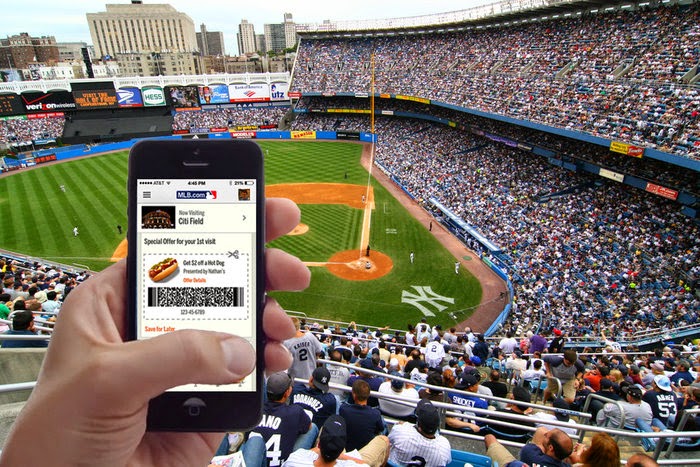
In a sport stadium your Mobile device could direct you to the fastest route from the parking-lot to your seat.

Video: Large cultural event successfully used iBeacon technology to enhance visitor experience.


60+ beacons were placed around the 35 acre site, and the multi-lingual iPhone and iPad app was created using the Locly online publishing platform. Visitors to the National Eisteddfod of Wales, used the app to view information that was relevant to what was nearby, such as activity schedules and competition results. They could also discover more information about exhibitors - from artists and performers to businesses and food menus. Notifications was used to welcome visitors and inform them of special offers and the latest news.


Sources: