Showing posts with label "Tourism". Show all posts

Saturday, 14 April 2018

Artificial intelligence, virtual reality: also for tourism

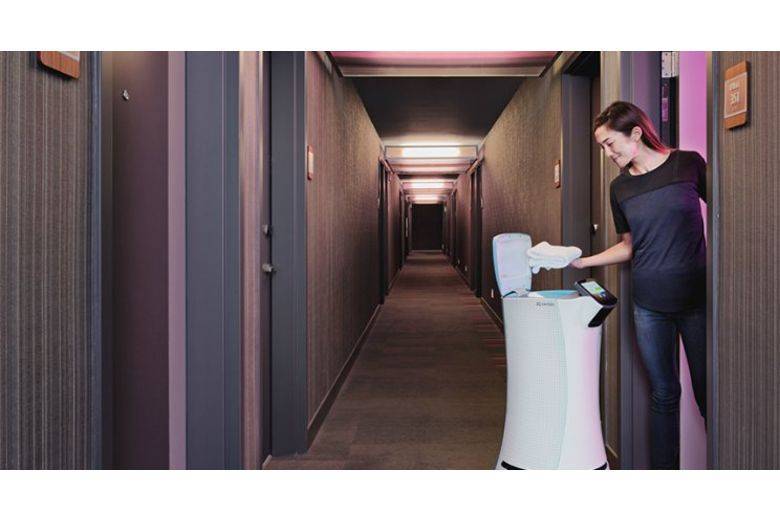
The Artificial Intelligence is a term applied when a machine has the capability to imitate intelligent human behavior. This totally new kind of technology is more and more developed and used in different areas and especially now in tourism. Artificial Intelligence is going to revolutionize the hospitality industry and the experience of the customers will totally change. For instance in future hotel the receptionist could be replaced by a mirror of facial recognition. Once the customers will be identified, the room will be adapted according to the guests’ wishes, such as the temperature, ambiance, lighting and so on. Thanks to the use of the personal database, the IA will totally personalize the service according to the preferences of the guest. This new technology is particularly used by luxurious hotels which answer to the high and exigent guests’ requirements. This new gadget is not only in favor of the guest but also hoteliers: they will strengthen their knowledge on their guests. The hotelier will know the needs of the clients before that they express their desires. The hotel will collect the guest information during the booking via internet but also thanks to the technology called “beacon”. Thanks to beacon, Artificial Intelligence will observe the habits of the customers then the hotel will keep the guests loyal by offering a personalized service or by selling them added products. For instance if the hotel knows that the guest is coming with his family, it will propose him a discount on the kid menu. This new type will strongly increase the hotel industry’s profitability. There is also another technology called Virtual Reality which enable users to perceive the hotel as a place instead of set of images. This gadget allow a hotel to reach a larger customer base as the guests can visualize themselves in their rooms, to visit the restaurant or swimming pool. To conclude the article suggests this new technology will increase the satisfaction of customers as well as the increase of the hotel revenue.
Image result for virtual reality tourismImage result for artificial intelligence hotels
image retrieved from: https://goo.gl/images/bFaj47 and https://goo.gl/images/8xpyWW
However, IA gives rise to a number of questions. According to a study published by Mckinsey & Company 66% of tasks performed in hospitality industry could be achieved by IA. It represents 53,9 million jobs across the globe, creating million of unemployed people if they are replaced by humanoids and robots. Are people ready to leave their jobs to machines ? The revolution of IA will for sure disrupt the tourism industry and encounters some pessimistics despite a huge potential: again according to Mckinsey & Company thanks to the increase in productivity and in wages, people’s demand for tourism will increase  and generate extra revenues and jobs in return. The next issue raised by IA will be around data protection. More and more data will be collected and used opening the way to even more cases like the Facebook Cambridge Analytica.

Would you trust IA to take care of you during your vacations? Would you be afraid to reveal even more personal data in order to receive a completely personalised experience ?

Wednesday, 21 March 2018

Robots in hotel industry


Thanks to the advent of the new technologies, robots came into being in last few years in several sectors such as medicine, automotive industry, electronic and more recently in hospitality. However, the emergence of robots in hotels remains for the moment a privilege of certain region where the high technology is well-developed like for example in Japan or Silicon Valley. The function of robots is to complete automated tasks and they are used in order to facilitate and improve the work of humans.

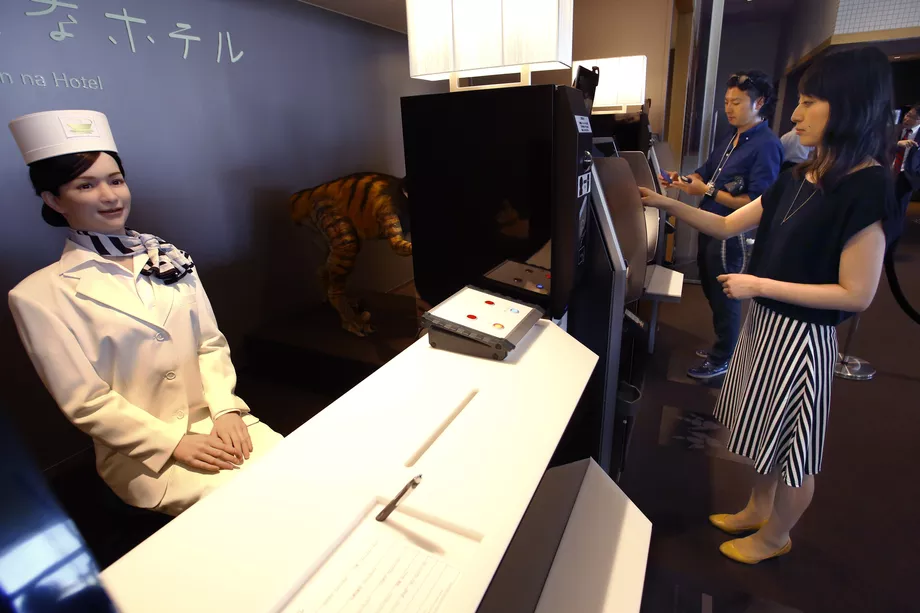
Source: https://www.curbed.com/2017/8/25/16201928/robot-hotel-japan-henn-na

Opening its doors in 2015, the Henn Na Hotel in Southwestern Japan bills itself as the world’s first hotel staffed by about 140 robots. Indeed, the visitors will be welcomed by a female receptionist humanoid speaking Japanese who will demonstrate how to check in or a dinosaur as English, Japanese or Korean receptionist.


Since its launch, this new kind of hotel has been a real success therefore the owner decided to open six others in Tokyo and three other ones in Osaka Prefecture by 2018. Moreover, 100 more robot hotels will be implemented in Japan and overseas. According to the Henn Na Hotel owner, there are two mains reasons why
using robots. First of all, it allows to cut the cost and secondly they help to increase the hotel’s efficiency.

Despite these advantages, the robot-as-staff phenomenon may rise some concerns.

Robots are more and more developed and nowadays there is still research made about this industry. Indeed, in the tourism and more in the hotel sector, robots can be an effective help and a good mean to attract new customers.

However, to use robots replacing real staffs, like in the Henn Na Hotel, can lead to a negative effect: robots will never replace human contact and dialogue. Some customers need to meet physically with someone. In addition, there is also a concern about security. Indeed, robots can not maintaining security as humans will do.


And you, have you already tried this kind of hotel? Would you like to go? What do you think about the presence of robots in the hotel?


Source: Barber, M. ; Budin, J. (2017, August 25).
Robot-run Japanese hotel plans world dominance with 100 new locations.
Retrieved from Curbed: https://www.curbed.com/2017/8/25/16201928/robot-hotel-japan-henn-na


Monday, 12 March 2018

A new way to visit museums


A New Way To Visit Museums: Virtual Reality, the new tool in the tourism industry

Source: https://www.goethe.de/en/kul/bku/20949031.html - Photo: Städel Museum

Since several years, Virtual Reality is more and more present in different industries. It is a big innovation of the 21st century, used in a lot of sectors: for example video games, medical industry, flight simulator for airline… Tourism industry isn’t an exception, VR begin to play an important role for this sector too. Indeed, you can now visit sites or destinations without being there in reality! It constitutes a big change for the destinations and for the travelers.

But now, you can also visit a museum and see arts through VR…


Nowadays, museums need to differentiate themselves from others in order to attract more customers. Indeed, technology and especially virtual reality is one of the tools used by museums. This new experience is a new way to engage young as well as older visitors.


Many museums have moved forward into this virtual reality tool. In 2015, the British Museum was one of the first to try this experience thought a weekend event dedicated to Bronze Age object or virtual tour of its Egyptian Gallery . The National Museum of Natural in Paris have launched its new permanent virtual reality installation where people can zoom in on creatures or standing right in front of an elephant with the aim to understand its magnitude. According to Bruno David, president of the museum, with the traditional means it was impossible to demonstrate the same experience. Other museums go even farther, with the example of Kremer Museum which exists only as a virtual space.

 Source: https://blog.britishmuseum.org/explore-ancient-egypt-in-our-virtual-reality-tour/ 
   
Even if VR has many advantages for the museums as well as for visitors, it also raises some concerns about sustainability and funding.  Indeed, the creation of VR programs is expensive notably for public institutions. However, in response to an increase in the number of request in VR installations, the company HTC introduced an initiative called VIVE Arts which funds and develops VR content for museums and cultural institutions.  

As we can see, VR is a big innovation and can allow people to better discover museum and arts, for instance it can attract more young visitor who are not necessarily attacked by museums. However, we think that VR cannot replace reality and physical visits: people can find everything on the Internet and see it through virtual reality is the same as in a screen of a computer. It’s not the same thing that seeing for example a tableau in reality.
Moreover, we have to draw limits to VR in museum, with the example of Kremer Museum. This museum is only a virtual space, so can we really consider it as a museum?

What about you? Would you try a museum with VR experience?


Source: Cigainero, J. (2018, March 12). European Museums Get Adventurous With Virtual Reality. Retrieved from The New York Times:
https://www.nytimes.com/2018/03/12/arts/european-museums-get-adventurous-with-virtual-reality.html

The end of lost baggages thanks to AI ?

In June 2018, IATA (International Air Transport association) will oblige all airline companies to track constantly every luggage. SITA, a multinational information technology company which provides IT and telecommunication services to the air transport industry, recently released a report explaining the opportunity to increase the traveller journey.
Indeed, thanks to the automatisation of the various processes through artificial intelligence, significant progresses could be made. The idea is to use connected systems that communicate between them without the help of human beings.
For airlines and IATA it is an opportunity to reduce the costs of baggages handling even though this cost has been divided by two in the last decade. It also improves industry image by showing that airlines take their responsibilities and care about their travellers.

Today most of baggages tracking is done with markers called RFID ( radio frequency identification). The Hong Kong airport is the first airport which has implemented these markers into its baggage handling central system. It allows the travellers to follow their luggages during the journey into the airport and reduce the stress or wait and thus insatisfaction. The airport is testing at the moment a system that enables the tracking of baggages trolleys with machine learning and image processing, with a precision rate of 92%. In the near future it will allow travellers to follow the baggages from the plane to the baggage claim.


Source: https://goo.gl/images/KmVqrA

Indeed, one of the most important trend according to the digitalization marketing is the Artificial Intelligence which is more and more used by the different tourism companies.
One of the most current problem that client meet during his travel is the loss of his luggage. According to the International Society of Aeronautical Telecommunication, 82 000 luggages per day are lost in the diverse airport all around the world and 10 000 in Europe. Moreover, 2,5% of the luggages lost are either definitely lost, broken or damaged.  
In 2010, 30 million luggages recorded have been lost. This kind of problem is due to either a mistake of points during the stopover, either a problem of bar code or an incorrect manipulation of the luggage.
Even if the client can be damaged, the airlines company can loss the loyalty of its guests and receive many complaints and consequently the company will see its brand image and reputation touched. Moreover this is a waste of time for the customer who is looking for a fast service during its travel.

That’s why, thanks to this new technology, this is will improve the satisfaction of the guest, they will be more reassure and relax during their travels and company will be more able to manage the follow up of the different luggages.
We can confirm that this new Artificial Intelligence will be more and more generalized in all the airports.


Source article: Pellegrin, H. (2018, March 07). Le potentiel de l'intelligence artificielle dans le tracking de bagages.

Autres source: Statistiques mondiales écologiques en temps réel*. (n.d.).

Retrieved March 12, 2018, from https://www.planetoscope.com/tourisme/944-nombre-de-bagages-perdus-dans-les-aeroports.html


Sunday, 19 March 2017

#Travel, Tourism Companies promoting their brands on Instagram


We have all heard about Instagram, followers, hashtags and so on.
Today, the social network is approaching tourism companies, as the latter can use it to communicate, promote their brands and target new customers.

Indeed, the largest sharing photo platform, launched in 2010, has reached a total number of 600 million monthly active users, and half of them are even considered as daily active!
More than 40 billion photos have been shared on the platform since its creation; and 75% of the most famous brands already use it, on a basis of almost 5 posts a week. Tourism brands use this network even more than other brands, and are for this reason, considered as the best Instagram presence at the moment.


But everyone can wonder, why tourism brands should communicate via this specific network?

Society has evolved; people and travellers want to be inspired and inspire others. They changed their way of discovering, consuming and sharing experiences. Indeed, 35% of Instagramers use the platform to discover new places and 48% to choose their travel destination. Statistics are even higher for Millennials who, for 89% of them, plan their travel activities according to fellow travellers’ content. 
Before booking any trip, travellers have the need to look at online reviews but also get “real” feedbacks. Millennials are aware of this new trend, as 97% share content of their travels.

Figures show that 75% of Instagramers act after seeing a post of a brand. They visit the website, research the brand’s products or even purchase it. They engage 10 times more than with Facebook! And the fact of having an active online presence, increase the brand perception up to 20%.

All in all, what tourism brands have to do, is:
  • Create a brand identity and build positive brand awareness, by showing followers they are valued.
  • Engage with users: communicate with them in real-time, encourage interactions, react to their complaints, and create significant relationships. It will humanize the brand, which will then be more appreciated and visible. 
  • Use the network to build databases of consumers and keep widening it.

How to use Instagram?
  • Be consistent: use high resolution images, and keep the same design (style or color). The objective is to create recognizable posts to represent the brand’s value and ideas; but also favor a long-term strategy by sharing posts frequently. (1/day or 5/week). Cross post pictures with other social media networks and marketing channels to drive people to the company’s Instagram page.
  • Keep sharing relevant content: be informed about the latest news, but do not use clichés or fads.
  • Think about Followers first: encourage interaction with them (comments), value followers generated content (pictures submission, photo contests), use influencers to boost the volume of users and enhance the brand (with the same values as the brand’s). Brands’ goal is to create a close relationship with its followers. All in all, tourists will become the brand’s promoters.


We can finally agree that this method is successful, as #Travel counts up to 162 million posts, so the market does exist.
Good examples of this success are: the official Tourism New Zealand account which has one of the biggest databases with more than 581K followers; but also, Fjord Norway, which succeeded in bringing the Natural Wonder Trolltunga to the world stage with Instagram.


Hurry up! Create your account and start positioning your brand! :)


References: